PizzaScience
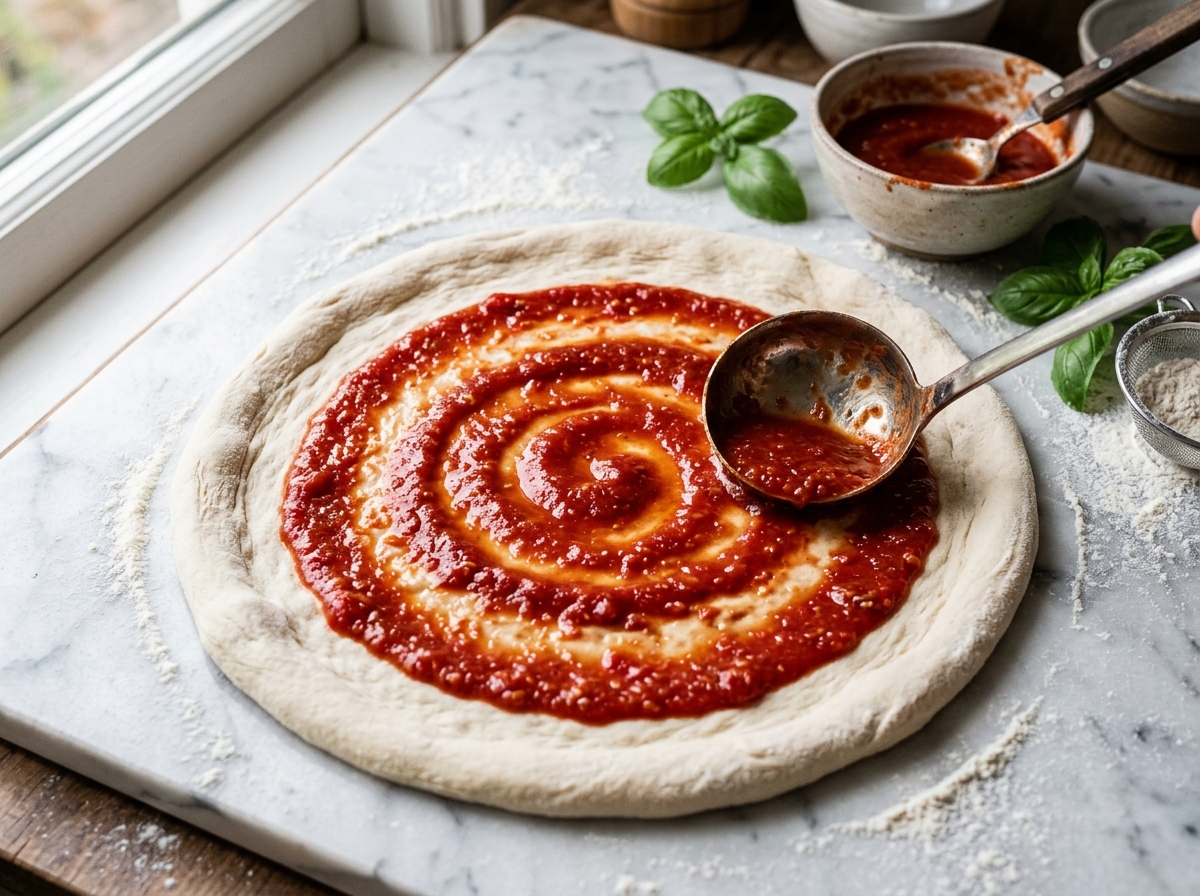
Hand-crushing whole San Marzano DOP tomatoes next to a blistered Neapolitan pizza slice with a dry, structured center
Topping Thermodynamics & Sensory Chemistry

Neapolitan Pizza Toppings Science: Why Pizzas Get Soggy, Pre-Bake vs. Fuori Forno & Umami Pairing Matrix

Water Activity Kinetics, Pectin Methylesterase Gelation, the 4 Thermal Regimes & Allosteric Receptor Synergy

Quick Answer: Why Do Neapolitan Pizzas Get Soggy in the Center?

1. The Physics of Soggy Center Syndrome: Starch Gelatinization vs. Evaporative Cooling

An extraordinary slice of Neapolitan pizza is governed by what Italian masters call scioglievolezza—an outer crust that crackles faintly for a microsecond under the tooth before yielding into a cloud-soft, melt-in-the-mouth crumb that fuses seamlessly with tomato and curd. When that balance collapses into a limp, translucent, soupy center that tears through the plate—known in Naples as la pasta cruda (“the swamp”)—the culprit is rarely the dough hydration alone. It is a thermodynamic collision on the top surface of the center disc.

When a 250g–270g dough ball is opened using the Neapolitan schiaffo technique, air is pushed outward into the perimeter rim (cornicione), leaving the central load-bearing floor just 2 to 3 millimeters thick. In a 485°C (900°F) wood-fired or gas kiln, the conductive floor (400°C–430°C biscotto di Casapulla clay) drives rapid bottom gelatinization while radiant infrared energy from the dome flashes surface moisture into steam. However, liquid water possesses a massive latent heat of vaporization (2,260 kJ/kg). Every extra gram of unbound water sitting on that 2mm center acts as a thermal heatsink: until that free water boils away, the underlying dough interface cannot climb past 100°C (212°F), halting starch swelling and gluten cross-linking into a wet, grey paste.

Latent Heat Barrier 2,260 kJ/kg Thermal energy required to phase-shift liquid water into steam. Excess water pins the center crust at 100°C, preventing Maillard setting.
Tomato Water Activity aw ≈ 0.99 Crushed tomatoes contain 93%–94% total water. Only intact cellular pectin networks prevent that water from flooding the dough.
Payload Limit (260g Dough) 120g – 140g Max Maximum combined pre-bake topping mass (~50% of dough weight) that a 2–3mm center disc can evaporate in a 60–90s bake.
The Parmigiano Anchor 10g – 15g Base Low-moisture (30% H2O) grated aged cheese dusted over tomato pulp absorbs free serum and prevents the “Sliding Avalanche.”

San Marzano DOP Pectin Methylesterase (PME) vs. Watery Salad Tomatoes

Why does genuine San Marzano dell’Agro Sarnese-Nocerino DOP (ecotypes Kiros and Fiano grown in the volcanic ash of Mount Vesuvius) cling to the dough like velvet, whereas standard plum or salad tomatoes weep a pink moat around the cheese? The answer lies in botanical anatomy and enzymatic cell-wall chemistry.

Unlike standard round tomatoes—which consist of large hollow cavities (locules) filled with watery placental gel—San Marzano tomatoes possess a thick, meaty outer pericarp wall and tiny internal seed pockets. Within this thick pericarp resides a dense network of insoluble protopectin and the endogenous enzyme pectin methylesterase (PME). When the fruit is gently crushed, PME de-esterifies galacturonic acid chains along the pectin backbone, allowing natural divalent calcium ions (Ca2+) enriched by volcanic soil to form “egg-box” calcium-pectate cross-links. This creates a thermostable, three-dimensional pectic hydrogel sponge that holds 93% water locked inside cellular pockets even under 485°C radiant heat. Furthermore, when a 5g–8g spiral of extra virgin olive oil (filo d’olio a 6) meets boiling tomato pulp in the oven, micro-turbulent steam convection emulsifies non-polar lipids with hydrophobic lycopene carotenoids, increasing bioaccessible cis-lycopene by 300% while mellowing citric/malic acidity (pH 4.25–4.45, 5.0–6.2° Brix).

Hand-Crushed or Food Mill (Passatutto)

  • Intact Pectic Hydrogel: Compresses pericarp walls along natural cellular cleavage planes, preserving the Ca2+ cross-linked pectin sponge that traps water on the dough.
  • Whole, Unbroken Seeds: Keeps the tough seed testa intact so internal astringent polyphenols and bitter tannins never leach into the sauce.
  • Ruby-Red Lycopene & Fresh Aldehydes: Zero air vortex incorporation preserves bright ruby color and fresh green-vine (E)-2-hexenal and (Z)-3-hexenal aromas.

High-Shear Electric Blender / Processor

  • Sheared Pectin & Immediate Syneresis: Spinning steel blades (>15,000 RPM) chop long-chain pectin polymers into short fragments, collapsing the gel and flooding the dough center with free water.
  • Seed Rupture (Bitter Polyphenols + Mucilage): Pulverizes tomato seeds, releasing bitter tannic oils and slick locular mucilage water directly into the puree.
  • Oxidative Bleaching: Whips micro-air bubbles into the sauce, oxidizing lycopene into a pale, chalky orange-pink foam before it ever reaches the oven.

Interactive Neapolitan Moisture Budget & Soggy Center Simulator

Adjust your sauce mass, mozzarella type, and Parmigiano anchor on a standard 260g dough ball to calculate free water load and center crust stability.

Target: 60g–80g strained San Marzano DOP
Target: 60g–80g drained batons
Total Topping Payload 157 g 60% of 260g Dough
Free Weeping Water 14.2 mL Unbound Syneresis Load
Evaporative Heat Demand 32.1 kJ In 60–90s Bake Window
Center Crust Status Dry & Crisp Scioglievolezza Optimal
Thermodynamic Diagnosis: Balanced Neapolitan payload. Intact San Marzano pectin gel and 6-hour drained fior di latte batons keep free syneresis below the 22 mL evaporative ceiling, allowing the 2.5mm center crust to set cleanly without pooling.

2. Pre-Bake (Stage 0) vs. Post-Bake / Fuori Forno (Stage 2 & 3) Thermal Architecture

A high-temperature pizza oven is not a slow-simmering casserole; it is a 485°C (900°F) thermal reactor where conductive heat from the stone floor and infrared radiation from the flame dome operate simultaneously. Every pizza topping possesses a specific thermal denaturation threshold, lipid melting point, and water activity (aw). Placing an aged cured meat or an unfermented cream emulsion into Stage 0 (Pre-Bake) destroys its cellular structure before the crust finishes rising.

In professional Neapolitan pizzaiolo architecture, toppings are deployed across Four Thermal Stages:

  • Stage 0 — Pre-Bake Foundation (T = 0s, 430°C–485°C Full Bake): Ingredients that require intense heat to gelatinize, melt, caramelize, or render fat into the sauce (San Marzano pulp, drained fior di latte, smoked provola, raw pinched salsiccia, guanciale, ’nduja, pre-sautéed friarielli, and dry wild oregano).
  • Stage 1 — Mid-Bake Flash Interruption (Last 20–30s in Oven): Delicate proteins or fragile petals that cook through in seconds but scorch or toughen in a full bake (fresh squid/calamari, zucchini blossoms brushed with ricotta/oil).
  • Stage 2 — Post-Bake Steam Crown / Fuori Forno (0s Off Peel, 65°C–80°C Residual Steam): Ingredients ruined by direct flame whose fats or emulsions awaken over escaping crust steam (Prosciutto di Parma DOP, Lardo di Colonnata IGP, Mortadella Bologna IGP, Burrata/Stracciatella, fresh wild arugula, and fresh basil leaves).
  • Stage 3 — Table-Side Ambient Finish (20°C–25°C Plating): Highly volatile aromatics and delicate sugar/acid glazes that vaporize or burn above 60°C (shaved fresh Black Winter Truffle, Colatura di Alici, 12-year Aceto Balsamico Tradizionale DOP, and hot infused honey).
Translucent ribbons of Prosciutto di Parma DOP, Lardo di Colonnata, and cool Burrata draped fuori forno over a steaming Neapolitan pizza crust
Figure 1: Stage 2 (Fuori Forno) thermal architecture—residual 75°C crust steam warms oleic-rich cured pork lipids to 32°C–35°C without denaturing muscle fibers or breaking cream emulsions.
Filter Matrix:
Master Neapolitan Topping Thermal Architecture Matrix: Moisture %, Water Activity (aw), Critical Thermal Thresholds & Optimal Staging
Topping Ingredient Moisture % Water Activity (aw) Thermal Threshold Optimal Stage Chemical, Rheological & Textural Reason
San Marzano DOP (Hand-Crushed) 93% – 94% aw ≈ 0.99 100°C boil; PME cross-links Ca2+ Stage 0: Pre-Bake Hand-crushing preserves insoluble pectin gel; high heat concentrates sugars (5.0–6.2° Brix) and converts trans-lycopene to bioavailable cis-isomers in EVOO.
Pomodorini del Piennolo DOP 88% – 90% aw ≈ 0.97 180°C skin blister; pulp jams Stage 0: Pre-Bake Thick, winter-cured volcanic pericarp prevents watery syneresis; bursts into concentrated malic-sweet jam pockets ideal for buffering Buffalo Mozzarella.
Fior di Latte (Cow's Milk) 52% – 58% aw ≈ 0.97 60°C – 65°C core casein melt Stage 0: Pre-Bake Cut into 8–10mm fiammifero batons and drained 6h; calcium-cross-linked casein micelles (pH 5.2–5.4) stretch into a continuous, non-oiling blanket.
Mozzarella di Bufala DOP 60% – 65% aw ≈ 0.98 >60°C rapid whey expulsion Stage 0 (Drained) Loose casein web and high fat (24%–28%) release heavy serum; requires 6–12h colander drainage + ≥430°C flash bake (or 90s split-bake in home ovens).
Burrata & Stracciatella 65% – 70% aw ≈ 0.98 >65°C cream emulsion breaks Stage 2: Fuori Forno Oven heat causes irreversible phase separation of unfermented heavy cream (panna) into watery serum and yellow grease; apply cool (16°C–18°C) post-bake.
Parmigiano-Reggiano DOP (36m) 29% – 32% aw ≈ 0.85 140°C Maillard & protein bridge Stage 0 (or Stage 2) Finely grated under mozzarella (10–15g), it acts as a hydrophilic sponge that absorbs tomato/whey moisture and anchors cheese to the crust.
Prosciutto di Parma DOP (24m) 48% – 52% aw ≈ 0.88 >60°C protein seizes; 35°C fat melt Stage 2: Fuori Forno Baking vaporizes remaining moisture, spiking salinity (5.5%+) and shrinking cured muscle into bitter shoe leather; residual steam melts fat ribbons at 35°C.
Guanciale di Maiale (Pork Jowl) 35% – 42% aw ≈ 0.85 32°C–35°C render; 150°C crisp Stage 0: Pre-Bake High oleic-acid jowl fat renders rapidly in the oven, frying the cured lean muscle into shatteringly crisp cracklings while basting the starch matrix.
Lardo di Colonnata IGP 15% – 20% aw ≈ 0.82 28°C – 32°C instant phase transition Stage 2: Fuori Forno In a 485°C oven, paper-thin marble-cured fat vanishes into smoke; draped immediately off the peel, it turns translucent and glazes the crust with rosemary aroma.
Mortadella Bologna IGP 55% – 60% aw ≈ 0.96 >70°C emulsion dries & sweats Stage 2: Fuori Forno Direct radiant flame blisters the delicate thermal pork emulsion into dry bologna and separates throat-fat cubes; fold onto hot pie post-bake with pistachio pesto.
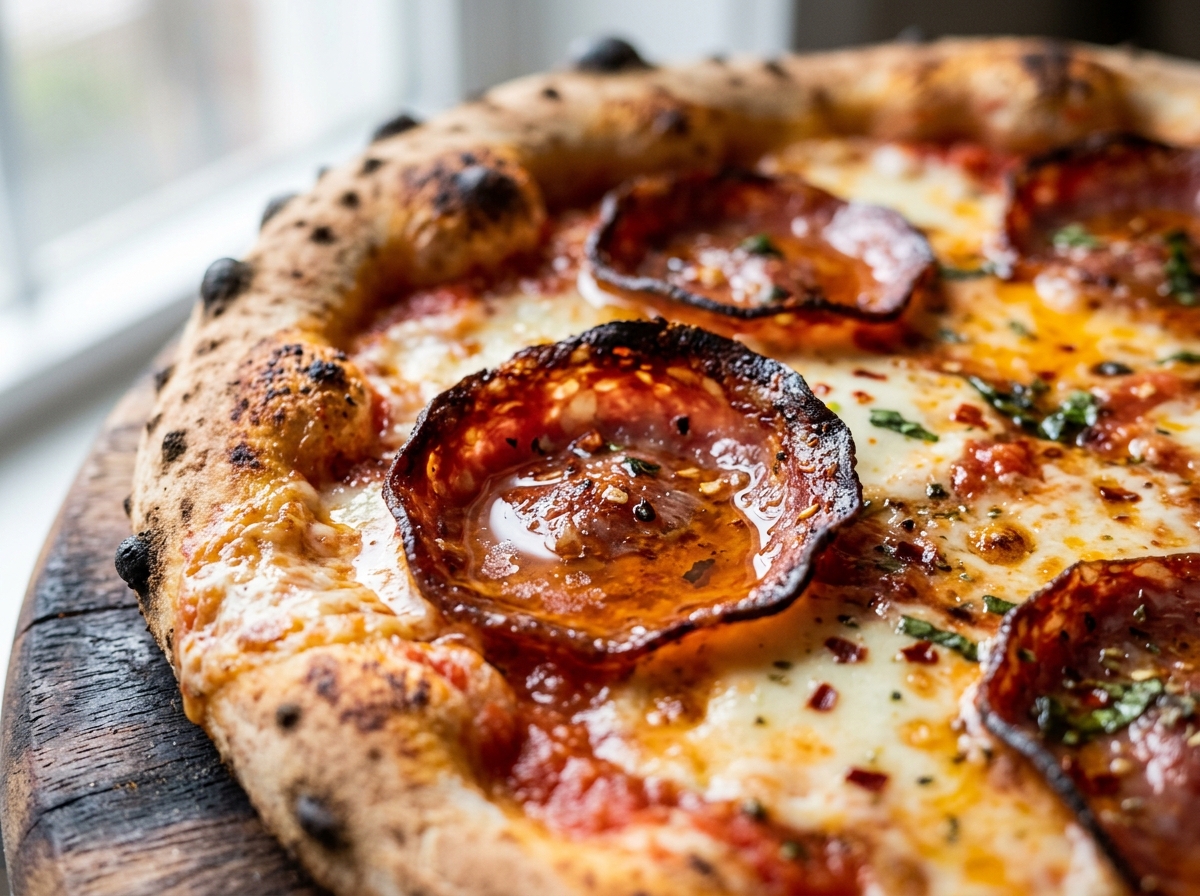
Spianata Calabra / Cupping Pepperoni 35% – 40% aw ≈ 0.85 160°C cup render; 200°C rim char Stage 0: Pre-Bake Natural collagen casing shrinks 20%–30% while top radiant heat dehydrates the upper face faster than the cheese-insulated bottom, curling into a micro-fryer chalice.
'Nduja di Spilinga 30% – 35% aw ≈ 0.84 40°C – 60°C complete lipid liquefaction Stage 0: Pre-Bake 70% soft pork fatback/belly and 30% Calabrian chili liquefy at 60°C into glowing crimson oil, dissolving non-polar capsaicin into melting mozzarella caseins.
Salsiccia Napoletana (Raw Pork) 58% – 62% aw ≈ 0.97 72°C core steam; 145°C Maillard Stage 0 (Raw 8g Pinch) Pinched raw into 6–10g nuggets, internal steam keeps the core juicy while surface Maillard reactions brown the meat and render fennel-anethole fat into the curd.
Cetara Salt-Cured Anchovies (Alici) 45% – 50% aw ≈ 0.78 100°C enzymatic dissolution in oil Stage 0 or Stage 2 Stage 0 fillets dissolve into hot tomato/EVOO as an invisible IMP umami foundation; Stage 2 fillets preserve firm, briny marine texture on Bufalina pies.
Fresh Wild Porcini (Boletus edulis) 88% – 92% (Raw) aw ≈ 0.99 Pre-sear >160°C before Stage 0 Stage 0 (Pre-Sautéed) Raw mushrooms dump 90% water onto dough; hard-searing trifolati in oil drives off free water and concentrates 1-octen-3-ol and GMP nucleotides before baking.
Friarielli (Neapolitan Broccoli Rabe) 86% – 90% (Raw) aw ≈ 0.99 Pan-fry (spadellati) prior to bake Stage 0 (Pre-Cooked) Wilted in olive oil, garlic, and peperoncino prior to Stage 0 to expel vegetal water; lipid-coated leaves char lightly in the oven without wetting the crust.
Wild Arugula (Rucola Selvatica) 90% – 92% aw ≈ 0.99 >55°C wilts & degrades erucin Stage 2: Fuori Forno Oven heat turns delicate leaves into slimy black mush and destroys the myrosinase-generated peppery isothiocyanate bite; pile cold over hot Prosciutto & Parmigiano.
Fresh Genovese Basil DOP 88% – 92% aw ≈ 0.99 >100°C polyphenol oxidase blackening Stage 0 (Shielded) / 2 Exposed leaves oxidize black and lose volatile linalool and eugenol; tuck under mozzarella in Stage 0 to infuse oil, or drop raw at Stage 2.
Wild Dried Sicilian Oregano < 8% aw ≈ 0.50 130°C–180°C lipid terpene extraction Stage 0: Pre-Bake Dehydrated cellular walls hold hydrophobic monoterpenes (65%–75% carvacrol and thymol) that bloom in hot olive oil and tomato steam without burning.
Fresh Black Truffle (Tuber melanosporum) 70% – 75% aw ≈ 0.96 >50°C dimethyl sulfide flash loss Stage 3: Table-Side Sulfurous aroma volatiles (dimethyl sulfide, bis(methylthio)methane) vaporize within seconds in oven heat; shave paper-thin at the table over 65°C cheese.

3. Synergistic Umami & Molecular Flavor Pairing on Pizza

Why do certain Neapolitan combinations—such as tomato, anchovy, and garlic (Pizza Romana/Napoletana), or porcini mushrooms, pancetta, and aged cheese (Pizza Boscaiola / Ciccianese)—trigger an almost involuntary, mouth-watering craving that far exceeds the sum of their parts? The mechanism is a biochemical chain reaction on the human tongue known as allosteric umami synergy.

Our taste buds detect savory protein depth via the heterodimeric G-protein-coupled receptor T1R1/T1R3. On the extracellular Venus flytrap domain of the T1R1 subunit sit two distinct binding sites:

  • The Primary Orthosteric Pocket (Free L-Glutamate): Binds free L-glutamic acid abundant in sun-ripened San Marzano DOP tomatoes (140–200 mg/100g), concentrated tomato paste (1,000–1,500 mg/100g), long-fermented wheat dough, and 24-to-36-month Parmigiano-Reggiano DOP (1,680–2,200 mg/100g).
  • The Secondary Allosteric Enhancer Pocket (5′-Ribonucleotides): Binds purine nucleotides—specifically Inosine-5′-Monophosphate (IMP) derived from ATP degradation in cured animal muscle and marine fish (Cetara salt-cured anchovies at ~350 mg/100g, 24-month Prosciutto di Parma, guanciale, and raw pork salsiccia) and Guanosine-5′-Monophosphate (GMP) concentrated in fungal cell walls (fresh and dried Porcini mushrooms at ~150–250 mg/100g and black truffles).

When L-glutamate binds alone, the T1R1/T1R3 Venus flytrap opens and closes transiently, transmitting a baseline 1x savory signal. When an IMP or GMP ribonucleotide simultaneously occupies the adjacent allosteric hinge site, it induces a conformational lock that clamps the receptor shut around the glutamate molecule. Neural firing intensity does not merely add together (1 + 1 = 2); it multiplies exponentially up to 400% to 800% (4x to 8x perceived umami intensity).

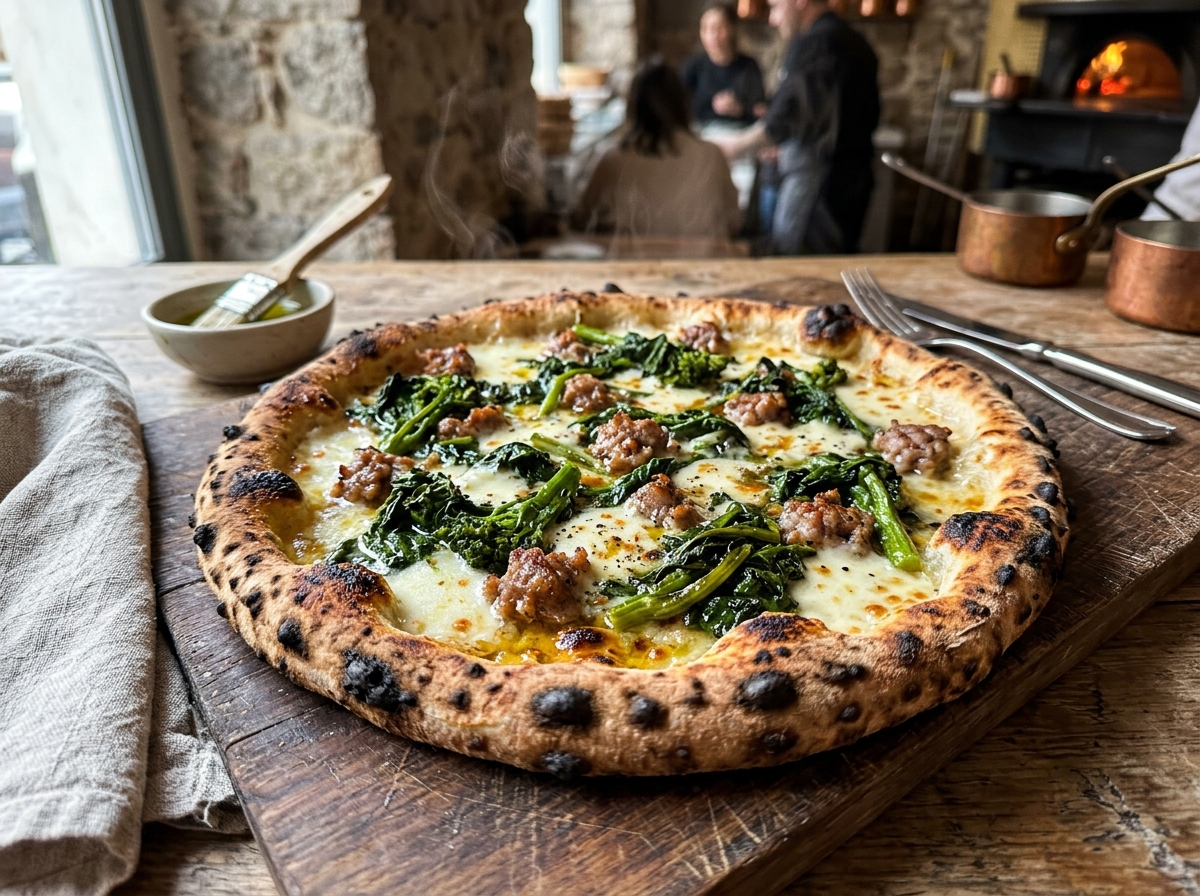
Neapolitan Pizza Salsiccia e Friarielli with rendered pork fennel sausage, charred broccoli rabe leaves, and melted smoked provola
Figure 2: Pizza Salsiccia e Friarielli—a textbook study in bitter glucosinolate palate cleansing, rendered pork oleic lipids, and wood-smoked guaiacol phenols.

The Salsiccia e Friarielli Equation: Bitter Glucosinolates vs. Rendered Pork Lipids

On white pizzas (Pizze Bianche) that omit acidic tomato sauce, high-fat cheeses and meats risk coating the tongue in an impermeable lipid film that causes palate fatigue after two slices. The iconic Neapolitan winter pizza Salsiccia e Friarielli solves this without a single drop of citric acid by harnessing bitter-lipid antagonism and volatile bridging:

  • Glucosinolate & Isothiocyanate Bitterness (Brassica rapa subsp. sylvestris): Neapolitan friarielli (tender winter broccoli rabe shoots) contain sulfur-rich glucosinolates (gluconapin and glucobrassicanapin) that hydrolyze into bitter, peppery isothiocyanates. On the palate, this assertive vegetal bitterness acts as a astringent detergent that scrubs rendered pork lard and dairy butterfat from the lingual papillae.
  • Lipophilic Solvation of Spice Volatiles: Conversely, raw knife-cut pork sausage (salsiccia a punta di coltello, 30% fat) renders warm liquid lard at 32°C–38°C. This non-polar fat acts as a solvent for hydrophobic aroma compounds—specifically sweet licorice trans-anethole from wild fennel seeds, pungent piperine from cracked black pepper, and fiery capsaicin from peperoncino—while simultaneously cushioning the harshness of the friarielli’s T2R bitter receptor activation.
  • Phenolic Smoke Bridging (Provola Affumicata): Straw-smoked provola from the Monti Lattari bridges the green sulfurous notes of the brassica and the roasted pyrazines of the pork via wood-smoke phenols (guaiacol and 4-methylguaiacol), while its naturally lower moisture (46%–50% H2O) prevents waterlogging under the sautéed greens.

Interactive Allosteric Umami Multiplier & Flavor Bridge Simulator

Combine a Free L-Glutamate base with a 5′-Ribonucleotide (IMP/GMP) booster and an Acid/Bitter lipid counterweight to model receptor amplification.

Receptor Amplification 7.8x Boost Allosteric Lock Active
Free Glutamate Density 425 mg Per 30cm Pizza Disc
5′-Nucleotide Load 88 mg IMP Marine Purine Cascade
Palate Equilibrium Harmonized Zero Lipid Fatigue
Molecular Pairing Analysis: High-concentration L-glutamate from San Marzano pulp and 36-month Parmigiano-Reggiano binds the primary T1R1 pocket while 5′-IMP from Cetara anchovies locks the allosteric hinge, generating an ~800% savory wave balanced by volcanic tomato acidity and carvacrol terpenes.

4. Super FAQ Hub: Neapolitan Topping Troubleshooting & Food Science

Below are the six most critical diagnostic and biochemical questions from professional and home pizzaioli, structured for rapid troubleshooting at the marble prep counter.

1. Why is my Neapolitan pizza soggy and soupy in the center?

Neapolitan pizza becomes soggy in the center (la pasta cruda) when the combined free water from crushed tomatoes (water activity aw ≈ 0.99, 93%–94% moisture) and weeping mozzarella whey (syneresis) exceeds the 60-to-90-second evaporative budget of a 250g dough ball stretched to 2–3mm in the center. Liquid water requires 2,260 kJ/kg of latent heat to vaporize; pooling water pins the center dough temperature at 100°C (212°F), preventing complete starch gelatinization and Maillard crust setting.

Root Cause

Overloading toppings (>140g total), using unstrained or machine-blended tomato puree, or placing cold, freshly sliced wet mozzarella directly onto the dough.

Actionable Protocol

Cap total pre-bake toppings at 120g–135g per 260g dough ball. Strain whole peeled San Marzano DOP tomatoes for 15 minutes and crush by hand. Cut fior di latte into 8–10mm fiammifero batons and drain in a colander for 6 hours.

2. Why should you never use a blender to make Neapolitan pizza sauce?

High-shear electric blender blades (>15,000 RPM) inflict three chemical defects on canned plum tomatoes: (1) Pectin Cleavage: Steel blades slice the long-chain insoluble pectin molecules cross-linked by pectin methylesterase (PME) and calcium ions, destroying the hydrogel sponge and causing instant water weeping (syneresis) on the dough; (2) Seed Fracture: Blades shatter the hard seed coats, leaching bitter astringent polyphenols, tannins, and slick seed mucilage water into the sauce; (3) Oxidative Bleaching: The vortex whips air into the pulp, oxidizing bright red lycopene into a dull pink-orange puree. Always crush tomatoes by hand or pass them through a low-shear food mill (passatutto).

3. Which pizza toppings must be added after baking (Fuori Forno)?

Any ingredient whose proteins denature into leather, whose cream emulsion breaks above 65°C, or whose volatile aromatics flash-vaporize must be staged Fuori Forno (Stage 2 or Stage 3). Specifically: Prosciutto di Parma DOP, San Daniele, Culatello, Lardo di Colonnata IGP, and Mortadella Bologna IGP must be draped at Stage 2 (0 seconds off the peel) so 70°C–80°C escaping steam melts their oleic fats (28°C–35°C) without cooking the meat or spiking salt concentration. Burrata and Stracciatella must be applied post-bake so their heavy cream (panna) does not separate into yellow grease. Wild arugula, fresh black truffles, Colatura di Alici, aged traditional balsamic vinegar, and hot honey must be added post-bake to protect heat-sensitive volatiles.

4. Should sausage be cooked or raw before putting it on a Neapolitan pizza?

Always apply fresh pork sausage (salsiccia) completely raw, pinched by hand into small 6-to-10-gram nuggets. A 6–10g raw morsel has low thermal mass and a high surface-area-to-volume ratio: in a 450°C–485°C oven (or under a domestic broiler on a baking steel), heat penetrates the core within 40–50 seconds. Intracellular water flashes into positive internal steam pressure that keeps the center juicy, while the exterior undergoes Maillard browning (>140°C) and renders fragrant fennel-infused lard into the surrounding mozzarella. Pre-browning sausage in a pan drives off its internal moisture in advance, causing the second bake in the pizza oven to dehydrate the meat into hard, grey gravel.

5. How does the 8x umami synergy work on pizza toppings?

The human umami taste receptor (T1R1/T1R3) contains a primary binding pocket for free L-glutamate and a secondary allosteric pocket for purine 5′-ribonucleotides (IMP and GMP). When you pair glutamate-rich plant/dairy bases—such as San Marzano DOP tomatoes (200 mg/100g) and 36-month Parmigiano-Reggiano (1,680–2,200 mg/100g)—with IMP-rich animal/marine toppings (Cetara anchovies at ~350 mg/100g, cured prosciutto, guanciale, or pork salsiccia) or GMP-rich fungi (sautéed wild Porcini mushrooms), the ribonucleotide binds the allosteric hinge and prevents glutamate release. This conformational lock multiplies neural umami signaling by 400% to 800% (4x to 8x).

6. Why do my toppings and cheese slide off the pizza slice in one sheet?

Known as the “Sliding Avalanche,” this structural failure happens when an excessive layer of cold tomato sauce or weeping mozzarella whey creates an unbonded aqueous slip-plane between the gelatinizing wheat starch of the dough and the melting casein blanket. To anchor the cheese permanently to the crust, dust 10g to 15g of finely grated Parmigiano-Reggiano DOP or Pecorino Romano directly over the crushed tomato sauce before laying down the mozzarella batons. The dry grated cheese (30% moisture) absorbs surface water and melts into the tomato pulp, forming a protein cross-bridge between the dough gluten and the melted curd.

New Release · Paperback & Kindle

Toppings and Desire: A Neapolitan Pizza Book of Ingredients, Science, and Stories

Go beyond dough hydration and master the upper half of the slice. Across 214 full-color pages, 60 photographic plates, and 78 technical schematic cards, explore the molecular chemistry of San Marzano pectic gels, Agerola fior di latte rheology, 8x allosteric umami cascades, and 19 authentic signature recipes contributed directly by 14 legendary master pizzerias from Naples, Caserta, Florence, Tokyo, and São Paulo.

  • Paperback Edition: 214 Pages, 60 Plates, 78 Schematics
  • Kindle Edition: Instant Digital Reference & Matrices
  • 10 Sacred Classics: Marinara to La Masardona's Pizza Fritta
  • 14 World Maestros: Enzo Coccia, Piccirillo, Manzi, Guidon & more

Topping & Moisture Architect

Build your custom pizza slice interactively: calculate exact gram weights, real-time syneresis water load, Stage 0 vs. Fuori Forno timing, and umami synergy scores.

Open Topping Architect

Toppings and Desire (Book)

Order the 214-page Paperback (60 plates, 78 schematic cards) or Kindle edition on Amazon to master every ingredient, thermal regime, and classic Neapolitan recipe.

Explore on Amazon