PizzaScience
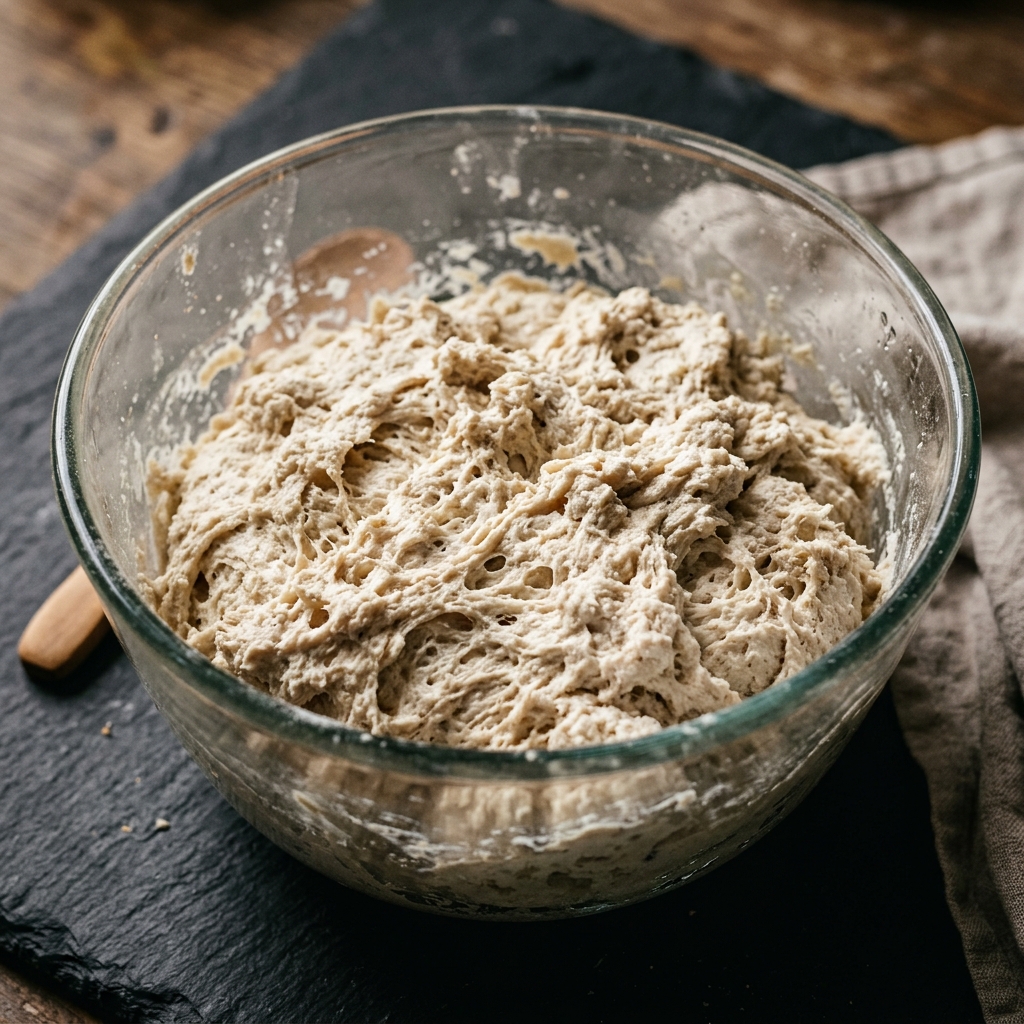
Close-up of shaggy, stiff Italian biga preferment in a glass bowl
Stiff Preferment

Biga: The Stiff Architect

A Biochemical & Thermodynamic Analysis of Structure and Acetic Complexity

science The Biochemistry of Biga

Developed by Italian bakers in the 19th century following the commercialization of baker's yeast, the traditional biga was designed to recover the deep aromatic complexity and structural strength that was lost when the industry transitioned away from long-fermented sourdoughs.

The defining feature of a biga ecosystem is its severe lack of free water. Typically formulated at a stiff hydration level between 45% and 60% (most commonly 50%), a biga uses a very strong wheat flour (with a Chopin W Index exceeding 300) and a minute quantity of yeast. This arid environment acts as a powerful biological restrictor, altering the kinetic pathways of the entire microbial population.

In a 50% hydration matrix, the protease and amylase enzymes are heavily restricted—they simply cannot move freely through the dense mass to interact with the starches and proteins. Consequently, the gluten network remains largely intact, avoiding the aggressive degradation and softening seen in liquid preferments. Furthermore, the dry, highly stressed environment forces yeast cells to struggle for moisture, slowing their metabolic rate and encouraging Lactic Acid Bacteria (LAB) to produce acetic acid over lactic acid. This specific acidic pathway generates the sharp, vinegar-like, and robustly rustic flavor profile characteristic of traditional Italian baking.

Biga vs. Poolish Comparison: While a stiff 45–50% hydration biga builds architectural dough strength and sharp acetic acidity, a wet 100% hydration Poolish preferment maximizes enzyme mobility to yield soft extensibility and buttery lactic sweetness. Use the Pizza Dough Recipe Calculator to dynamically switch and compare baker's percentages for both methods.

insights Dough Rheology & Architectural Metrics

Because biga preserves the gluten skeleton from excessive proteolysis, it imparts immense strength, elasticity, and gas-retention capabilities to the final dough matrix.

Optimal Hydration 45% - 50% Stiff, crumbly texture limits enzyme mobility to preserve gluten scaffolding.
Flour Strength Target W > 300 Strong, high-protein flour is required to endure long fermentation timelines.
Acidity Profile Acetic Acid Yields a sharp, tangy, vinegar-like flavor and a rustic baked perfume.
Rheological Impact Tenacity & Strength Provides elastic "bungee cords" that support highly hydrated final doughs.

compare_arrows Dough & Baked Results

done Baked Crust Characteristics

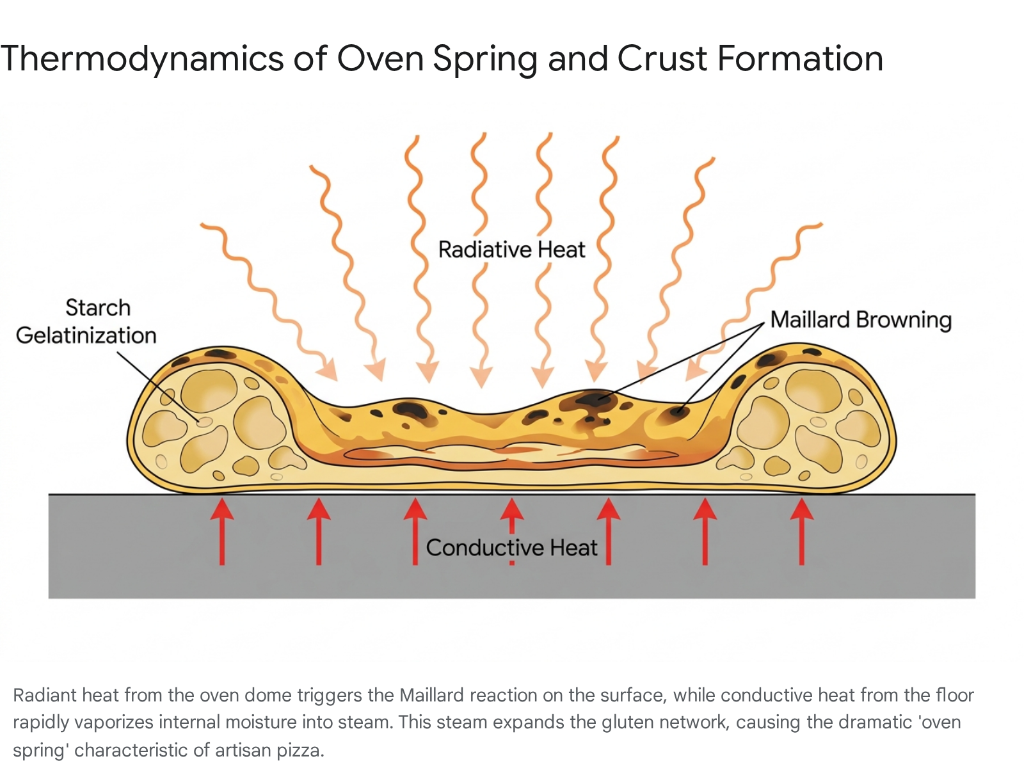
  • check_circle Explosive Oven Spring: Highly resilient gluten walls inflate like high-pressure balloons, forming massive vertical Canotto-style rims.
  • check_circle Uniform, Structured Crumb: Alveoli are organized and supported by thicker, deeply structured cell walls, translating to a satisfying chew.
  • check_circle Even Browning: Produces a uniform, deeply golden-brown crust rather than aggressive spot-blistering.

info Handling & Mixing Dynamics

  • arrow_forward High Stability: Requires 16 to 48 hours of fermentation, making it extremely error-tolerant and stable against temperature spikes.
  • arrow_forward Bassinage Required: The stiff, tense preferment must be broken into chunks and hydrated gradually to prevent tearing the gluten.
  • arrow_forward Digestibility: Extended enzymatic maturation pre-digests starches and degrades gas-producing FODMAPs.
Thermodynamics of Oven Spring and Crust Formation Diagram

assignment Step-by-Step 100% Biga Protocol

Engineered for a spring-to-summer ambient temperature of 75°F (24°C), this advanced method utilizes a 2-hour room-temperature start followed by a 16–24 hour cold retardation. This recipe yields exactly four 265g pizza balls (65% final hydration).

calculate Thermodynamic Math: Desired Dough Temperature (DDT)

To hit the target DDT of 75°F (24°C) in a warm room, apply the Total Temperature Factor (TTF) formula:
Target Water Temp = (DDT × 4) - (Room Temp + Flour Temp + Preferment Temp + Friction Factor)
Applying: (75 × 4) - (75 + 75 + 75 + 4) = 71°F (21.6°C). For final mix, water must be chilled to 71°F. To counteract intense mechanical mixing friction, the bassinage sequence requires ice-cold water (~40°F / 4°C).

Phase 1: Preferment Initialization Day 1 - 2:00 PM
Ingredients: 640g Strong Flour, 320g Water (65°F), 3g Instant Dry Yeast (IDY)
Dissolve the 3g of yeast completely in the 320g of water. Pour the yeasted liquid directly over the 640g of dry flour. Do not knead. Use your fingertips to aggressively rub, pinch, and shred the flour and water together. Continue until you obtain a shaggy bowl of dry, torn dough chunks. Ensure no loose flour remains at the bottom, but the mixture must remain rough and unkneaded.
Phase 2: Combined Fermentation Day 1 - 4:00 PM to Day 2 - 12:00 PM
Process: 2h Room Temp + 16-24h Cold Retardation
Cover the bowl of shaggy biga chunks loosely and let it sit at room temperature (75°F) for exactly 2 hours to awaken the yeast. Then, seal the container airtightly to lock in moisture and transfer it to the refrigerator (39°F / 4°C) for 16 to 24 hours of cold retardation.
Phase 3: The Bassinage Integration Day 2 - 12:00 PM
Ingredients: Cold Biga, 96g Ice Water (40°F), 18g Fine Sea Salt
Tear the cold, stiff biga mass into small, golf-ball-sized chunks. Place them into a mixing bowl and add half of the remaining ice water (48g). Squeeze the chunks aggressively with your hands. Once it forms a cohesive, lumpy mass, sprinkle in the 18g of salt (which tightens the gluten). Begin the eau de bassinage: add the remaining 48g of ice water in tiny splashes, kneading continuously. Do not add the next splash until the previous one is fully absorbed. Knead until it transforms into a smooth, elastic, taut dough ball.
Phase 4: Bulk Rest & Balling Day 2 - 12:30 PM
Process: 1h Bulk Rest + Dividing & Shaping
Let the dough ball rest on the counter covered by an inverted bowl for 1 hour to allow the highly tense gluten to relax. Divide the dough into four equal pieces of exactly 265g. Shape each piece into a tight, seamless ball, pulling the edges underneath to build vital surface tension. Place the shaped balls in an airtight proofing box.
Phase 5: The Appretto & Bake Day 2 - 1:30 PM to 5:30 PM (Dinner)
Process: 3-4h Final Rise + Max Heat Bake
Allow the dough balls to undergo their final rise (appretto) at 75°F for 3 to 4 hours. They are ready to bake when they have relaxed outward and doubled in size. Stretch carefully by pushing air bubbles from the center to the rim. Top lightly, launch onto a pre-heated baking steel/stone at max temperature, and bake until you get explosive vertical oven spring and a deeply caramelized, chewy rim.
calculate

Dynamic Calculator

Launch the PizzaScience calculator with the Stiff Biga preset selected to automatically scale ingredients, water temperature, and yeast splits.

Open Calculator
menu_book

Mastering the Rise

Unlock the deep biochemical and thermodynamic science of professional pizza-making in our comprehensive guide book on Amazon.

Get the Book