PizzaScience
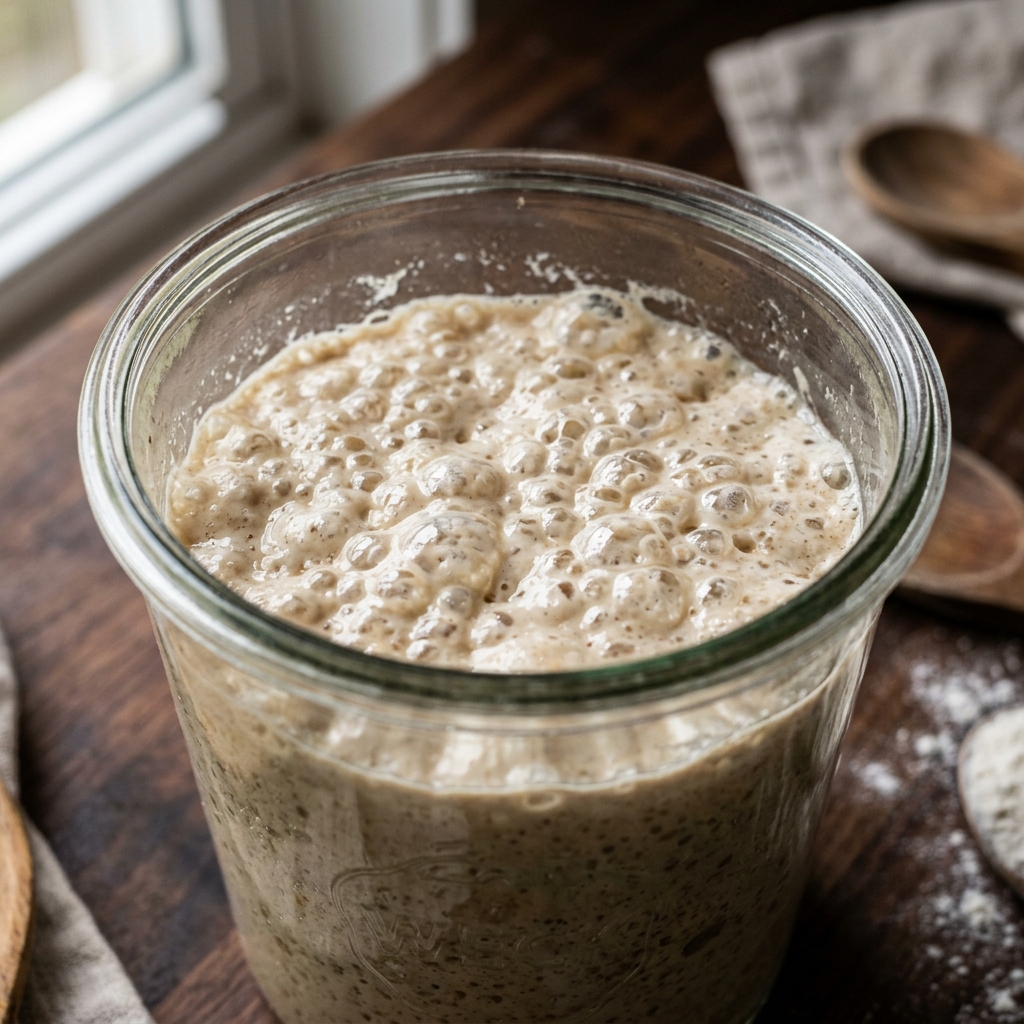
Close-up of highly active, bubbling poolish preferment in a glass container
Liquid Preferment

Poolish: The Liquid Catalyst

A Biochemical & Thermodynamic Analysis of Extensibility and Lactic Sweetness

science The Biochemistry of Poolish

Originating with Polish bakers before being adopted and refined by the French baking establishment, poolish is a highly hydrated, liquid pre-ferment. By strict definition, a poolish is formulated at exactly 100% hydration, meaning it consists of equal parts flour and water by weight, inoculated with a microscopic amount of commercial yeast (typically 0.1% to 0.3%).

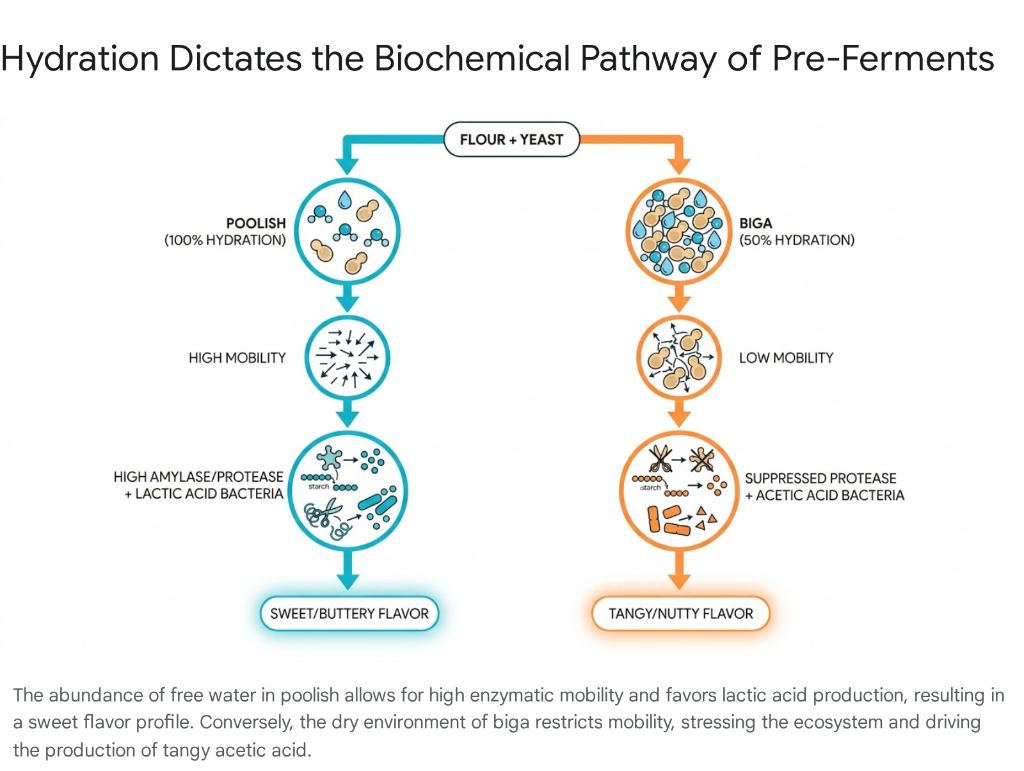
The defining characteristic of a poolish is its highly saturated, aqueous environment. The abundance of free, un-bound water allows for absolute maximum mobility of yeast cells, bacteria, and inherent flour enzymes. Because the environment poses zero hydration stress on the yeast cells, fermentation occurs at a highly accelerated rate.

In this liquid medium, the amylase and protease enzymes operate at peak efficiency. The rapid amylolysis produces a vast surplus of simple reducing sugars, saturating the liquid matrix. Simultaneously, aggressive protease activity rapidly cleaves glutenin bonds within the preferment mixture. Furthermore, the wet, highly mobile environment strongly favors the proliferation of Lactic Acid Bacteria (LAB) over acetic strains. Lactic acid yields a mild, sweet, and creamy flavor profile reminiscent of yogurt or butter, steering the aromatic profile entirely away from vinegar notes and heavily toward buttery, sweet, and mildly wheaty characteristics.

A standard poolish is highly sensitive to ambient temperature and peaks relatively quickly, usually within 12 to 16 hours at room temperature. A slight, unexpected increase in ambient heat can cause a poolish to over-ferment, causing the yeast to exhaust its sugar supply and the unrestricted protease to liquefy the protein structure completely.

Poolish vs. Biga Comparison: While a 100% hydration poolish prioritizes extensibility and buttery lactic sweetness, a stiff 45–50% hydration Biga preferment restricts enzyme mobility to produce immense structural elasticity and sharp acetic complexity. Use the Pizza Dough Recipe Calculator to dynamically switch and compare baker's percentages for both methods.

Hydration Dictates the Biochemical Pathway of Pre-Ferments Chart

insights Dough Rheology & Architectural Metrics

When a mature poolish is incorporated into the final dough mix, its aggressive enzymatic history fundamentally alters the dough's overall rheology, yielding extreme pliability.

Optimal Hydration 100% Equal parts flour and water by weight create a wet, soup-like starter.
Yeast Load Target 0.1% - 0.3% A microscopic pinch of yeast is required to prevent over-fermentation.
Acidity Profile Lactic Acid Yields buttery, sweet, and creamy notes with zero rustic vinegar sourness.
Rheological Impact Extreme Extensibility Weakens the gluten network intentionally to allow effortless, thin stretching.

compare_arrows Dough & Baked Results

done Baked Crust Characteristics

  • check_circle Massive Alveoli: The weakened, compliant gluten network expands rapidly with minimal resistance, creating irregular, translucent air pockets.
  • check_circle Leopard Spotting: High residual sugars from long liquid amylase activity carbonize instantly at 900°F, creating a beautifully blistered crust.
  • check_circle Light, Melting Crumb: The baked crust is extremely airy and tender, literally melting on the tongue with sweet, nutty notes.

info Handling & Mixing Dynamics

  • arrow_forward Effortless Stretching: Opens across the knuckles with zero "snap back," letting you create perfectly thin bases with ease.
  • arrow_forward Friction Control: Being a liquid batter, it integrates quickly with other ingredients, minimizing machine friction and overheating.
  • arrow_forward Nutrient Bioavailability: Pre-digested gluten and organic acids lower the Glycemic Index and digest with absolute ease.

assignment Step-by-Step Poolish Protocol

Meticulously calibrated for an ambient room temperature of 75°F (24°C), this protocol utilizes a 30% preferment flour ratio and generates exactly four 265g pizza dough balls with a total final hydration of 65%.

calculate Thermodynamic Math: Desired Dough Temperature (DDT)

To hit the target DDT of 75°F (24°C) in a warm room, apply the Total Temperature Factor (TTF) formula:
Target Water Temp = (DDT × 4) - (Room Temp + Flour Temp + Preferment Temp + Friction Factor)
Applying: (75 × 4) - (75 + 75 + 75 + 4) = 71°F (21.6°C). Therefore, the water added during the final dough mix must be chilled to exactly 71°F (21.6°C) to keep yeast activity under control.

Phase 1: Poolish Initialization Day 1 - 8:00 PM
Ingredients: 200g Flour, 200g Water (75°F), 0.2g Instant Dry Yeast (IDY)
Dissolve the microscopic pinch of yeast (0.2g) completely into the water in a clear container. Add the 200g of flour and stir vigorously with a spoon or spatula until a thick, smooth, pancake-like batter forms. Ensure absolutely no dry flour clumps remain. Cover the container loosely to allow gases to vent, and leave undisturbed at 75°F for 12 to 14 hours.
Phase 2: Visual Maturity Check Day 2 - 9:30 AM
Process: Visual Confirmation (The "À Point")
Inspect the poolish container. The mixture should have tripled in volume, smelling pleasantly sweet, yeasty, and slightly alcoholic. The surface must be covered in thousands of tiny, active bubbles (looking like tapioca pudding). Look for the à point: the exact moment the domed center of the bubbling batter begins to show slight dimpling or receding. This is the peak moment to mix.
Phase 3: The Final Mix Day 2 - 10:00 AM
Ingredients: Mature Poolish, remaining 440g Flour, remaining 216g Water (71°F), 18g Salt
Pour the remaining 216g of water (chilled to 71°F) into a large bowl. Pour the sticky, mature poolish into the water, using wet hands to dislodge it and stir gently to break it up. Add the remaining 440g of dry flour. Mix by hand using the "pincer method" to cut through the dough. Once a shaggy, cohesive mass forms, sprinkle the 18g of sea salt over the top to slow down the yeast. Knead gently until the dough reaches the Punto di Pasta—a smooth, elastic ball.
Phase 4: Bulk Fermentation & Rest Day 2 - 10:30 AM
Process: 2h Room Temp Bulk + Stretch & Fold
Cover the dough bowl with an airtight lid and allow it to rest at 75°F for 2 hours. At the 60-minute mark, open the bowl and perform one gentle set of "stretch and folds" (pulling the edges of the dough up and folding them over the center) to align the gluten strands and build structural tension.
Phase 5: Dividing, Appretto & Baking Day 2 - 12:30 PM to 5:30 PM (Dinner)
Process: 4-6h Final Rise + Max Heat Bake
Divide the dough on a clean work surface into four equal pieces of exactly 265g. Shape each piece into a tight, round ball, sealing the bottom. Place the balls in an airtight proofing box. Let them relax and rise (appretto) at 75°F for 4 to 6 hours. When doubled in size, stretch carefully (avoid crushing the rim), top, and bake on a pre-heated steel or stone at maximum temperature for a light, melt-in-the-mouth, blistered crust.
calculate

Dynamic Calculator

Launch the PizzaScience calculator with the Liquid Poolish preset selected to automatically scale ingredients, water temperature, and yeast splits.

Open Calculator
menu_book

Mastering the Rise

Unlock the deep biochemical and thermodynamic science of professional pizza-making in our comprehensive guide book on Amazon.

Get the Book