PizzaScience
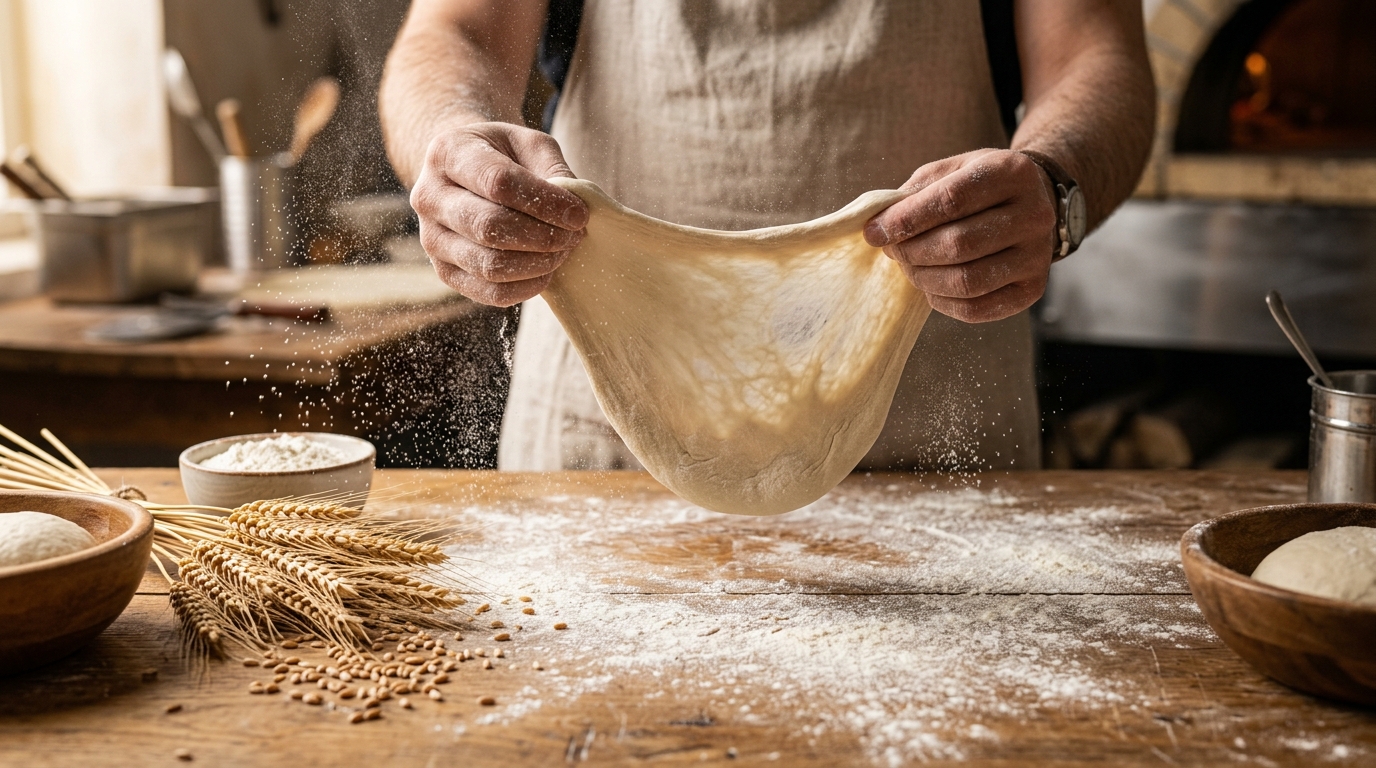
Artisan baker stretching translucent pizza dough windowpane test on floured wooden worktable
Cereal Science & Rheology

Pizza Flour Science & Crust Mastery

Flour Strength (W Index), Chopin Alveography, Protein Chemistry & Gluten Architecture

bolt Quick Answer: What Is the Best Flour for Pizza Dough?

biotech 1. The Molecular Chemistry & Physics of Flour Strength

To understand why some pizza doughs stretch effortlessly into translucent disks while others tear down the center or violently snap back like rubber bands, we must examine the wheat kernel (Triticum aestivum).

Flour is not an inert white powder; it is an active biochemical matrix composed primarily of starches (70%–75%), proteins (9%–15%), moisture (12%–14.5%), lipids (1%–2%), and minerals (ash, 0.4%–1.8%).
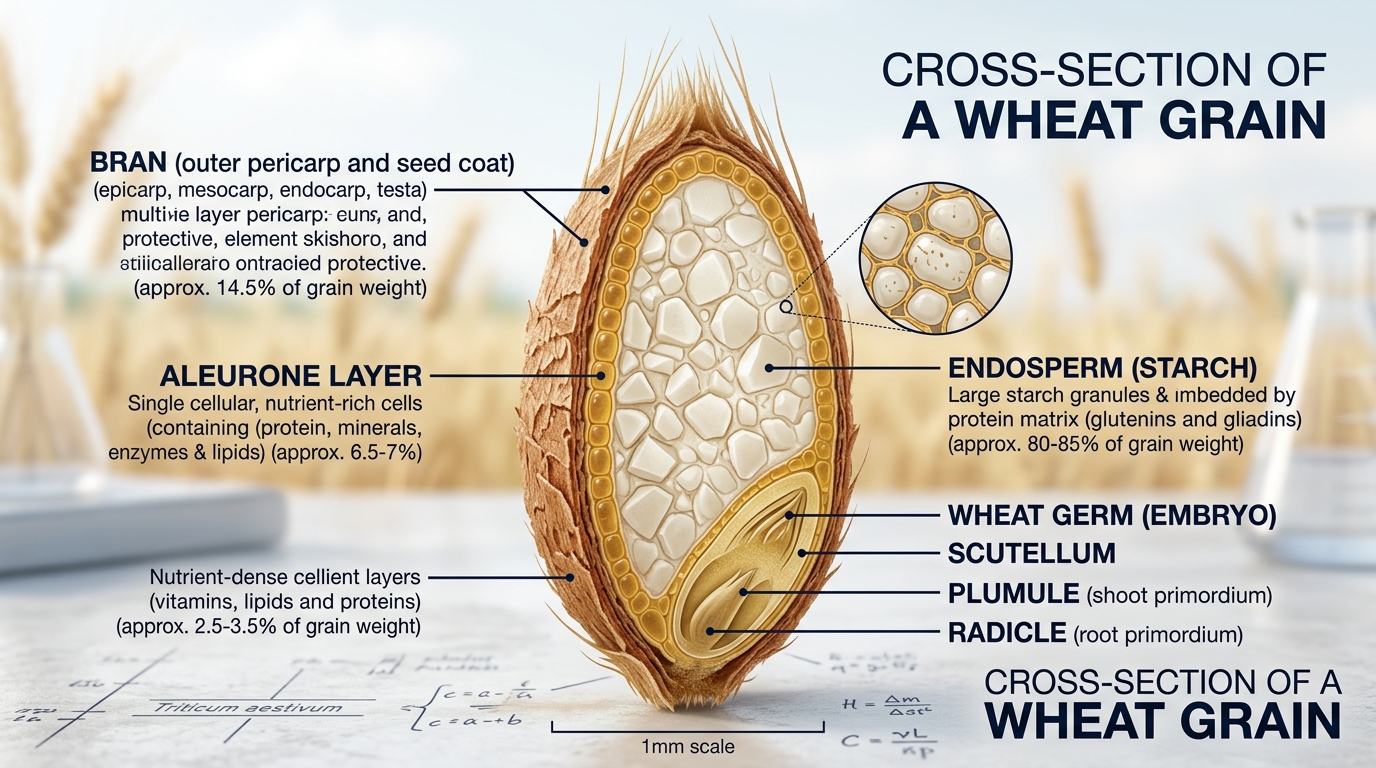
Cross-section diagram of wheat grain showing Bran, Aleurone Layer, Endosperm Starch, and Germ

Figure 1: Morphological cross-section of the wheat berry and extraction layers.

Gliadin (Monomeric) Extensibility & Flow Low molecular weight globular protein acting as a plasticizer. Allows dough to stretch outward without tearing.
Glutenin (Polymeric) Elasticity & Tenacity High molecular weight protein coiled chains with disulfide (-S-S-) bonds. Provides snap-back and structural gas retention.
Starch Matrix 70% – 75% Mass Amylose and amylopectin granules that gelatinize during baking, capturing escaping steam to set the crumb structure.
Pentosans (Ash) 10x–15x Water Pull Arabinoxylans in outer bran layers sequester free water, requiring higher hydration in Tipo 1, Tipo 2, and Integrale flours.

info Total Protein Percentage vs. Protein Quality

A common misconception among home bakers is that protein percentage alone equals flour strength. A flour with 14% total protein derived from low-grade wheat with unbalanced gliadin-glutenin fractions or damaged protein structures can yield a weak, slack dough that disintegrates during a 24-hour ferment. True dough strength is determined by the structural quality and rheological performance of the gluten macropolymers (measured on an Alveograph), not merely nitrogen mass.

tune 2. Laboratory Rheology: Chopin Alveograph & Brabender Farinograph

In professional Italian mills (molini), flour is characterized through objective rheological instrumentation. The two foundational gold standards are the Chopin Alveograph and the Brabender Farinograph.

The Chopin Alveograph inflates a salted dough disk into a bubble until it pops, recording an Alveogram that measures:

  • Tenacity (P, Peak Height in mm H₂O): Resistance to initial stretching forces. High P = stiff, elastic dough.
  • Extensibility (L, Curve Length in mm): Maximum length before popping. High L = easy hand-stretching without tears.
  • Deformation Energy Index (W, in 10⁻⁴ Joules): Total integrated area under the curve. Quantifies total gluten baking strength.
  • Configuration Ratio (P/L): The balance between tenacity and extensibility. The Neapolitan sweet spot is 0.50 to 0.70 (optimal 0.55–0.60).

query_stats Interactive Chopin Alveograph Simulator

Adjust Tenacity (P) and Extensibility (L) or select presets to explore the Alveogram curve, W strength, and dough handling dynamics.

Presets:
Resistance to deformation (Glutenin density)
Length before rupture (Gliadin flow capacity)
Flour Strength (W) W 280 Strong (Forte)
P/L Ratio 0.55 Ideal Sweet Spot
Fermentation Window 12–24 Hours Ambient / Cold Retard
Max Safe Hydration 62% – 66% Direct / Preferment
Dough Handling Diagnosis: Optimal Neapolitan balance. Stretches effortlessly without shrinking back or tearing in the center. Produces a tall, airy cornicione with great oven spring.

timeline 3. The W Strength Spectrum: Mapping Strength to Fermentation Time

The W index directly dictates the fermentation endurance of flour. During fermentation, yeast enzymes and natural flour proteases gradually hydrolyze and soften the gluten framework.

If a weak flour is fermented too long, its gluten network dissolves into a soupy puddle. If a super-strong flour is baked too quickly, the unbroken gluten bonds produce a rubbery, dense disk.

Strength Class W Index Range Protein Range Recommended Fermentation Optimal Pizza Style
Weak (Debole) W 90 – 160 9.0% – 10.5% < 2 Hours Unsuitable for pizza (Cookies, delicate pastry, waffles)
Medium (Media) W 180 – 240 10.5% – 11.5% 4 to 8 Hours (Direct) Thin-crust bar pies, quick flatbreads, same-day focaccia
Strong (Forte) W 250 – 310 11.5% – 13.0% 12 to 24h Ambient / 24–48h Cold Classic Traditional Neapolitan (AVPN), Roman Pala
Super-Strong (Rinforzo) W 320 – 420+ 13.5% – 15.5%+ 48 to 72h+ Cold / 100% Biga Contemporary Canotto, 75%+ Biga, Panettone, Blends

balance 4. Italian Flour Classifications vs. American Flour Systems

The fundamental difference between Italian and American flours lies in their regulatory legal frameworks: Italy classifies soft wheat flour strictly by ash content (mineral extraction), whereas the US classifies flour by functional protein percentage and wheat season (Hard Red Spring, Hard Winter, Soft White).

Italian Flour Type Max Ash (% dry) Min Legal Protein Extraction Rate Dough Performance & Ash Impact
Tipo 00 0.55% 9.00% ~70% (Central endosperm) Silken, bright white, maximum extensibility, zero bran friction.
Tipo 0 0.65% 11.00% ~72%–75% Standard white flour. Excellent structural gluten backbone for high hydration.
Tipo 1 0.80% 12.00% ~80% Partial bran & germ retained. Nutty rustic aroma, slightly higher water pull.
Tipo 2 0.95% 12.00% ~85% Semi-integral. High fiber, rich flavor, requires 5%–10% higher hydration.
Integrale 1.70% 12.00% 100% (Whole grain) Full bran flakes. Sharp edges cut gluten strands; best blended at 10%–20%.
Flour Grade / Name Protein % Enzymatic Malt Added? Target Oven Environment Best Pizza Applications
Italian Tipo 00 (Pizzeria) 11.5% – 12.8% NO (Unmalted) 800°F–950°F Wood / Gas Ovens Authentic AVPN Neapolitan. Prevents rapid scorching.
Italian Manitoba 00 14.0% – 15.5% NO (Unmalted) 800°F–900°F Gas / Electric 48–72h cold ferments, 100% Biga, blending reinforcing base.
US All-Purpose Flour 10.0% – 11.7% Usually YES 450°F–500°F Standard Home Oven Focaccia, thin crust bar pizza, short same-day doughs.
US Bread Flour (King Arthur) 12.5% – 13.0% YES (Malted Barley) 500°F–550°F Home Oven + Steel NY Style, artisan home pizza, excellent Maillard browning & chew.
Durum Semola Rimacinata 12.5% – 14.0% NO All Oven Temperatures Peel dusting (prevents sticking); 10%–20% blend for golden crunch.

local_fire_department Interactive Oven & Flour Compatibility Checker

Select your baking setup to instantly check flour compatibility and prevent burning or pale crusts.

verified
Perfect Match: Authentic Neapolitan Performance

Unmalted Italian Tipo 00 flour is engineered for high heat (850°F+). The absence of malt prevents bitter black scorching, allowing a 60–90 second bake with tender cornicione and delicate leopard spotting.

pie_chart 5. Diverging Standards: Traditional AVPN vs. Contemporary Canotto

history_edu Traditional Neapolitan (AVPN)

  • check_circle Flour Strength: W 250 – 310, P/L 0.50–0.70 (Target 0.60).
  • check_circle Hydration: 56% to 62.5% (Direct dough method).
  • check_circle Fermentation: Strictly ambient (20°C–23°C) for 8 to 24 hours.
  • check_circle Bake & Rim: 485°C for 60–90s. Soft, foldable a libretto with 1–2 cm rim.

rocket_launch Contemporary Canotto Style

  • check_circle Flour Strength: W 340 – 400+, P/L 0.55–0.65 (High elasticity).
  • check_circle Hydration: 70% to 80%+ (Preferments: 100% Biga or Poolish).
  • check_circle Fermentation: 18h Preferment + 48–72h Cold Retardation (4°C).
  • check_circle Bake & Rim: 430°C–460°C for 75–100s. Massive 3–4 cm puffed honeycomb rim.

blender 6. Flour Blending & Master Formulations Calculator

In professional pizzerias, millers and pizzaioli blend flours using the mathematical Pearson Square Method to reinforce weak supermarket flours, hit precise fermentation targets (e.g. W 280), or introduce flavorful whole grains without sacrificing structural gas retention.

The final strength represents a weighted linear mass balance:

Wtarget = (WA × %A) + (WB × %B)

To keep this scientific reference guide clean and easy to consume, our interactive blending engine, commercial brand database, and scalable master formulations have been organized into a dedicated interactive sub-page:

Interactive Application

Flour Blending Engine & Scalable Master Recipes

Access our dedicated Pearson Square calculator to compute exact mass ratios for any two flours, browse the complete commercial brand specification database (Caputo, King Arthur, Central Milling), and dynamically scale precision formulas for Neapolitan, Canotto Biga, and Home Oven doughs.

blender Open Flour Blending Engine
Included Features: check_circle Flour Blending Engine check_circle Commercial Brand Specs check_circle 3 Scalable Master Recipes

build 7. Diagnostic Troubleshooting: Flour & Rheology Disasters

cancel Dough snaps back violently and refuses to stretch to size expand_more

Underlying Rheological Cause

Excessive tenacity (P/L > 0.80). Flour strength is too high for a short fermentation, or dough balls were opened while still cold (< 60°F / 16°C), keeping gluten coiled tight.

Actionable Corrective Protocol

Extend bench relaxation time by 1–2 hours before opening. Increase recipe hydration by 2%–3% or switch to a flour with balanced P/L (0.50–0.60).

cancel Dough tears easily in center; overly slack and translucent expand_more

Underlying Rheological Cause

Flour strength was too weak (W < 220) for the fermentation timeline, or severe proteolytic degradation (overfermentation) dissolved gluten chains into liquid peptides.

Actionable Corrective Protocol

Shorten fermentation duration or lower ambient temperature. Upgrade to W 280–320 flour or blend 30% Manitoba flour using the Flour Blending Engine.

warning Crust is pale, dry, and white in domestic home oven expand_more

Underlying Rheological Cause

Unmalted Italian Tipo 00 flour was baked at low domestic temperatures (< 550°F / 290°C), where thermal Maillard browning cannot occur without enzymatic amylase assistance.

Actionable Corrective Protocol

Switch to malted American Bread Flour (King Arthur Bread) or add 1.0% diastatic malt powder / honey and 2.0% olive oil to preserve crust moisture.

cancel Crust scorches with black bitter char within 45 seconds in pizza oven expand_more

Underlying Rheological Cause

Malted American flour, sugar, or olive oil was introduced into a high-temperature pizza oven (> 850°F / 450°C), incinerating free reducing sugars instantly.

Actionable Corrective Protocol

Strictly omit all sugars, malt, and oil. Use authentic unmalted Italian Tipo 00 flour (Caputo Pizzeria / Cuoco) and dust the launch peel with semola rimacinata.

help_center 8. Frequently Asked Questions (FAQ)

Can I use all-purpose flour for pizza dough? expand_more
Yes, all-purpose flour (10%–11.5% protein, W 180–220) works well for same-day thin crust bar pizza. However, it cannot support high hydration (>62%) or extended cold fermentations (>24 hours) without breaking down into a sticky dough.
What is the exact difference between Caputo Blue and Caputo Red? expand_more
Caputo Pizzeria (Blue) is rated W 260–270 and is optimized for 12–24 hour direct ambient room-temperature fermentation. Caputo Chef / Cuoco (Red) is rated W 300–320 with higher protein stability, engineered for 24–48+ hour cold refrigerator retardation and higher recipe hydration.
Can you add Vital Wheat Gluten to strengthen weak flour? expand_more
Adding 1%–2% vital wheat gluten increases protein mass, but it primarily boosts tenacity (P) rather than extensible elasticity, often resulting in rubbery dough. Blending with naturally strong wheat like Italian Manitoba using our Flour Blending Engine is far superior rheologically.
Why dust pizza peels with Semolina instead of standard flour? expand_more
Durum wheat semolina (semola rimacinata) has a coarse, granular particle size that rolls like microscopic ball bearings beneath the dough. It does not absorb moisture as rapidly as flour and will not scorch into acrid black smoke on a 900°F oven stone.
calculate

Dynamic Calculator

Launch the PizzaScience calculator to automatically compute baker's percentages, water temperature, and yeast scaling for any flour strength.

Open Calculator
menu_book

Mastering the Rise

Unlock the deep biochemical and thermodynamic science of professional pizza-making in our comprehensive guide book on Amazon.

Get the Book